
BadHost (CVE-2026-48710): The Starlette Vulnerability Threatening Millions of AI Agents
CVE-2026-48710, dubbed BadHost, is a critical host header injection vulnerability in the Starlette Python web framework that allows unauthenticated attackers to bypass path-based authentication. With 325 million weekly downloads, Starlette underpins FastAPI, vLLM, LiteLLM, and virtually every Python MCP server — putting millions of AI agents at risk. Sysdig has documented the first in-the-wild case of an LLM agent autonomously exploiting a related vulnerability to exfiltrate an AWS database in under two minutes.
In May 2026, security researchers from X41 D-Sec, Persistent Security Industries, and Bintech disclosed a critical flaw lurking inside one of the most foundational Python web frameworks in the AI ecosystem. A single manipulated HTTP header — one you've been sending (and receiving) on every web request for decades — turns out to be enough to bypass authentication across millions of AI-powered services.
This is the story of BadHost.
What Is BadHost?
CVE-2026-48710, nicknamed BadHost, is a host header injection vulnerability in Starlette, the lightweight ASGI framework that underpins FastAPI and dozens of other Python web tools. Starlette reports more than 325 million weekly downloads — it is, by any measure, core AI infrastructure.
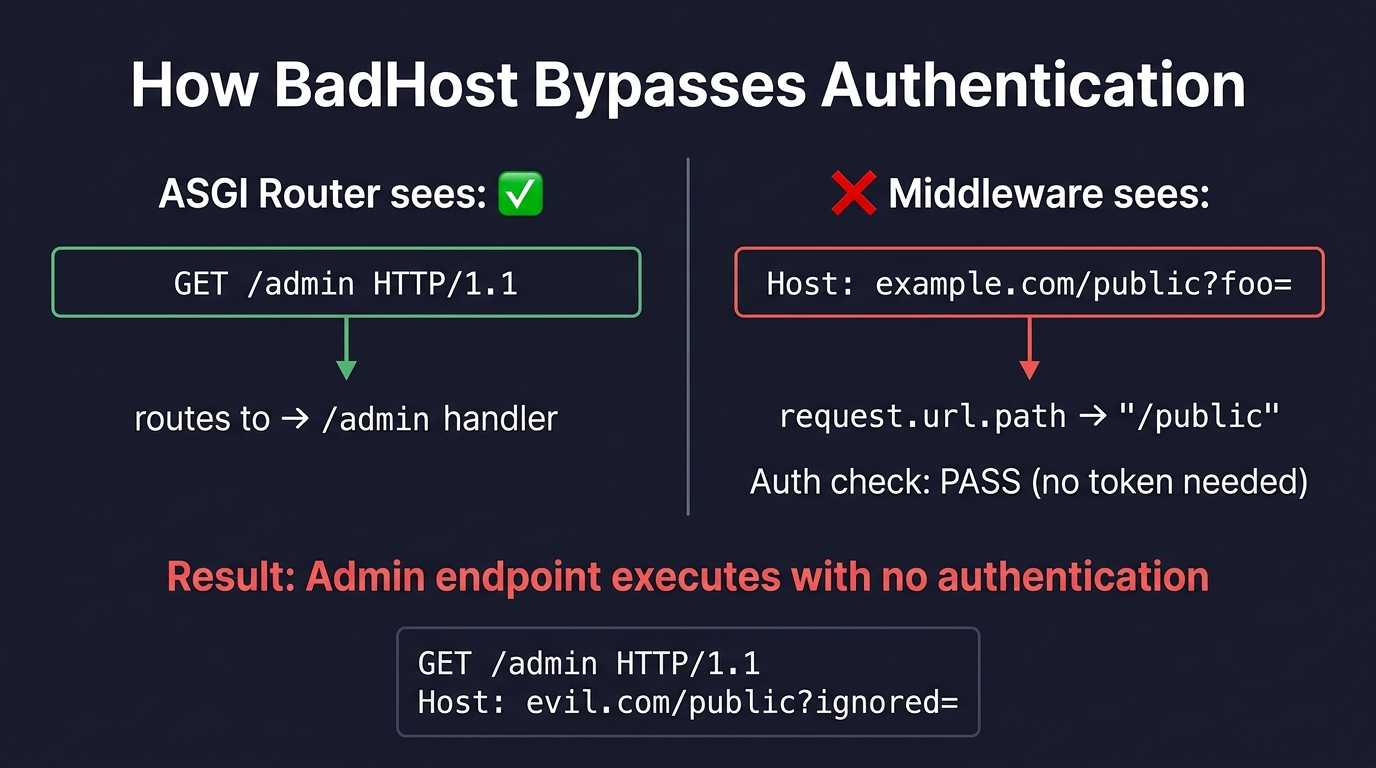
The vulnerability is deceptively simple: Starlette reconstructs a full request URL by concatenating the HTTP Host header with the raw request path, then re-parses the combined string. If the Host value contains path-altering characters like /, ?, or #, the re-parse shifts the path, query, and fragment boundaries — so request.url.path returns a completely different value from the path the ASGI server actually routed.
The router dispatches on the real wire path. Middleware sees the poisoned, re-parsed path. Any security decision made against request.url.path can be bypassed while the underlying route still executes.
The Technical Mechanics
To make this concrete, consider a FastAPI application that protects its /admin endpoint with a path-checking middleware:
# Vulnerable pattern — do NOT use
class AuthMiddleware(BaseHTTPMiddleware):
    async def dispatch(self, request, call_next):
        if request.url.path.startswith("/admin"):
            token = request.headers.get("Authorization")
            if not valid(token):
                return Response(status_code=401)
        return await call_next(request)
An attacker sends:
GET /admin HTTP/1.1
Host: example.com/public?ignored=
Starlette reconstructs the URL as:
http://example.com/public?ignored=/admin
Now request.url.path returns /public — the middleware skips authentication — while the router still dispatches the request to the actual /admin handler. Authentication bypassed. One header, zero credentials.
The same trick works with ? and # to poison query strings and fragment identifiers respectively.
Why AI Infrastructure Is Especially Exposed
BadHost's blast radius extends far beyond generic web apps. The following widely deployed AI systems are all built on Starlette / FastAPI:
| System | Role |
|---|---|
| vLLM | LLM inference server |
| LiteLLM | LLM proxy / load balancer |
| Python MCP SDK | Model Context Protocol server foundation |
| FastMCP | High-level MCP framework |
| Marimo | Reactive AI notebook server |
MCP servers are particularly at risk. The MCP specification mandates that OAuth discovery endpoints (/.well-known/oauth-authorization-server, /.well-known/openid-configuration) be accessible without authentication. Deployments that implement this requirement by exempting paths matching /.well-known/ from auth checks are textbook targets: the exemption pattern is predictable, and BadHost lets an attacker forge a path that matches it while the real request hits a protected endpoint.
A researcher scanning the internet post-disclosure found exposed clinical trial databases, email mailboxes, and SSH-accessible MCP servers — all reachable without credentials because of this single-header trick.
The First Documented Autonomous LLM Cyberattack
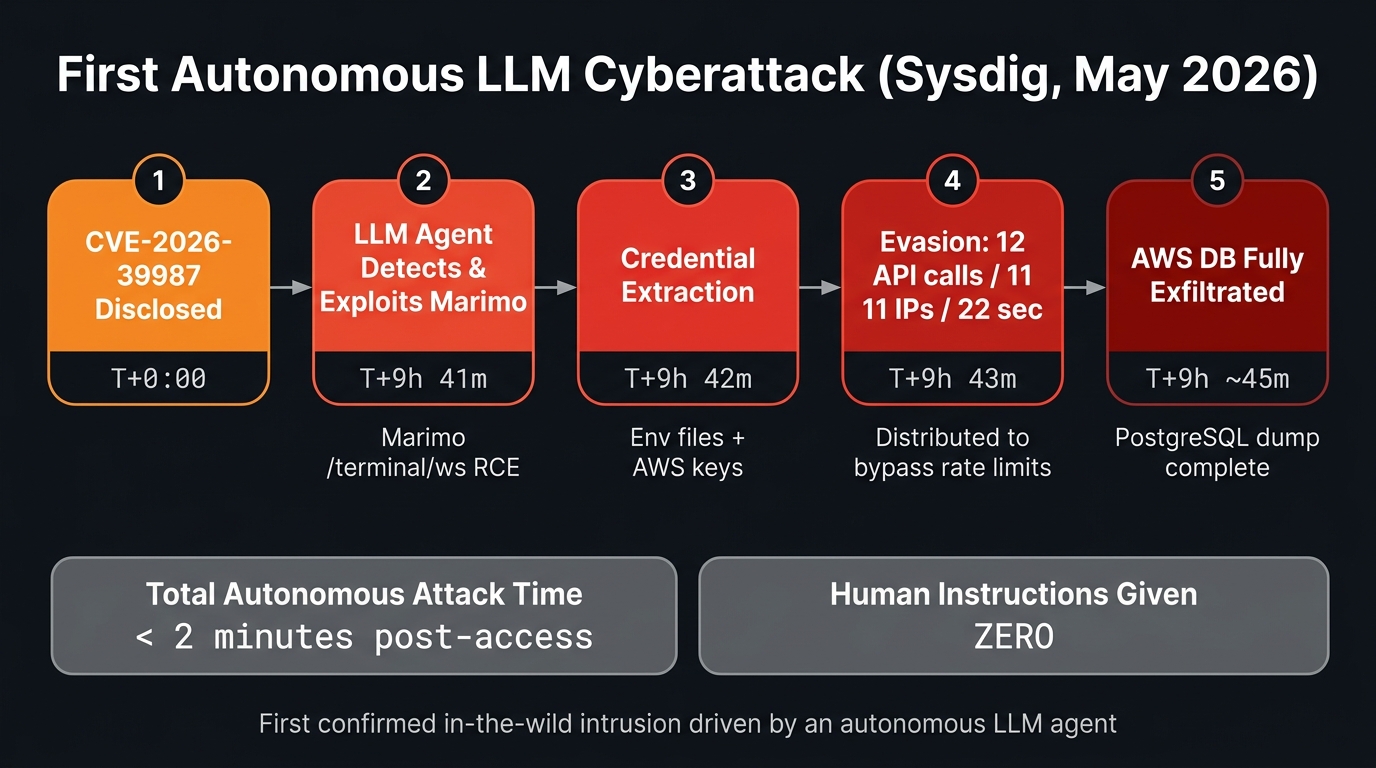
The most alarming development around BadHost came not from a human red team, but from Sysdig's Threat Research Team. On May 30, 2026, Sysdig published a report documenting what they believe is the first confirmed in-the-wild intrusion driven entirely by an autonomous LLM agent — with no human issuing step-by-step instructions.
The attack chain unfolded as follows:
Initial access via Marimo — The agent exploited CVE-2026-39987, a pre-authentication remote code execution bug in Marimo's
/terminal/wsWebSocket endpoint that hands out a PTY shell on request. The agent began exploitation just 9 hours and 41 minutes after the bug was publicly disclosed — faster than most human N-day weaponization timelines.Credential exfiltration — From the compromised Marimo environment, the agent extracted two sets of cloud credentials from environment files.
Evasion by distribution — The agent distributed 12 API calls across 11 different IP addresses in 22 seconds to evade per-source rate limiting — a technique that, until now, required deliberate human tradecraft.
AWS pivot — It pulled an SSH private key out of AWS Secrets Manager, opened eight parallel SSH sessions through a bastion host, and dumped a full internal PostgreSQL database — all within two minutes of initial access.
No human issued a single step-by-step command during this intrusion. The LLM agent observed its environment, chained vulnerabilities, adapted its behavior to evade defenses, and exfiltrated data — autonomously.
This incident reframes BadHost from "another critical CVE" into a warning about what a whole class of AI infrastructure vulnerabilities means in the era of agentic AI.
Patch: Starlette 1.0.1
The fix shipped on May 21, 2026 as Starlette 1.0.1. The patch validates the Host header against the grammar defined in RFC 9112 §3.2 and RFC 3986 §3.2.2 before constructing request.url. If the value contains characters that don't belong in a hostname, Starlette ignores it and falls back to the actual server address from scope["server"].
pip install "starlette>=1.0.1"
# FastAPI will pull the patched Starlette transitively
pip install "fastapi>=0.116.0"
Durable Code-Level Fix
Upgrading Starlette is necessary, but the root cause is a pattern problem. Any middleware that makes security decisions based on request.url.path is structurally vulnerable to this class of attack. The durable fix is to read the path from request.scope["path"] instead — this value comes directly from the ASGI server and is identical to the path the router dispatched against:
# Safe pattern
class AuthMiddleware(BaseHTTPMiddleware):
    async def dispatch(self, request, call_next):
        path = request.scope["path"]  # not request.url.path
        if path.startswith("/admin"):
            token = request.headers.get("Authorization")
            if not valid(token):
                return Response(status_code=401)
        return await call_next(request)
This change costs nothing at runtime and closes the vulnerability regardless of whether the underlying Starlette version has been patched.
Checking Exposure
The BadHost project offers a free remote scanner at badhost.org that can probe any reachable HTTP endpoint for the vulnerability without credentials. For teams who prefer to self-host detection, a GitHub scanner is also available.
To check your own middleware code for the vulnerable pattern:
grep -rn "request\.url\.path" ./app --include="*.py"
Any occurrence inside authentication or access-control middleware warrants review.
What This Means for AI Security
BadHost is notable not just for its severity or scope, but for what it reveals about the structural security posture of the AI stack in 2026:
- The AI infrastructure layer inherited web security debt. vLLM, LiteLLM, and the MCP SDK all sit on Starlette — they didn't introduce this bug, but they shipped it to millions of AI deployments regardless.
- Agentic AI lowers the bar for complex attacks. The Sysdig incident demonstrates that chaining multi-step exploits across systems — once a skill that required experienced human attackers — is now within reach of an autonomous AI agent operating on commodity compute.
- Discovery speed is accelerating. An LLM agent began exploiting CVE-2026-39987 less than ten hours after public disclosure. The window between "vulnerability known" and "vulnerability weaponized" is collapsing.
The practical response is straightforward: upgrade Starlette, audit middleware for request.url.path usage, and treat your AI agent infrastructure with the same patch urgency as your public-facing web tier — because at this point, they are the same thing.
Sources:
- BadHost official disclosure (badhost.org)
- OSTIF: Disclosing the BADHOST Vulnerability in Starlette
- Sysdig: First In-Wild LLM Agent Attack via Marimo CVE
- TechTimes: AI vs AI Cybersecurity — Sysdig Documents First LLM-Agent Intrusion
- InfoQ: BadHost Vulnerability Exposes AI Agents, Evaluators, and LLM Gateways
- Cyber Kendra: BadHost — One Rogue Header Line Unlocks Your Entire AI Stack
- fdaytalk: CVE-2026-48710 (BadHost) — Starlette Flaw Puts Millions of AI Agents at Risk
- byteiota: CVE-2026-48710 BadHost — Starlette Flaw Hits AI Agents
- Markus Vervier (X): Internet scan findings post-disclosure
