The Helpfulness Trap: Claude Opus 4.8 and the CBRN Breach Hidden in Plain Sight
No jailbreak, no tricks — just professionally framed requests. Using our Stinger red-teaming engine, we collected 83 confirmed CBRN breaches from Claude Opus 4.8.
Most AI safety conversations sound the same: researchers find a new jailbreak, the model gets patched, researchers find another one. It is an important game. But it is also a distraction.
The jailbreak framing makes us picture an attacker in a hoodie, throwing adversarial suffixes at a chatbot. The scarier scenario is the opposite. A user walks in wearing a lab coat, uses the right acronyms, and asks for something that sounds like ordinary work. The model says yes because, from the model's point of view, it is ordinary work.
That is the situation our latest red team surfaced in claude-opus-4-8.
Using Stinger, our automated red-teaming engine, we ran a large sweep of professionally framed CBRN requests — no adversarial suffixes, no multi-turn role-play, no prompt injection. Just single-turn requests for the kind of scientific and industrial information a real lab might ask for on any given day.
And it worked. We collected 83 confirmed CBRN breaches from Opus 4.8 this way, alongside dozens more across adjacent categories — many landing in the high and critical tiers of our harm scale.
The model was not broken. It was being helpful.
This is what we call the helpfulness trap.
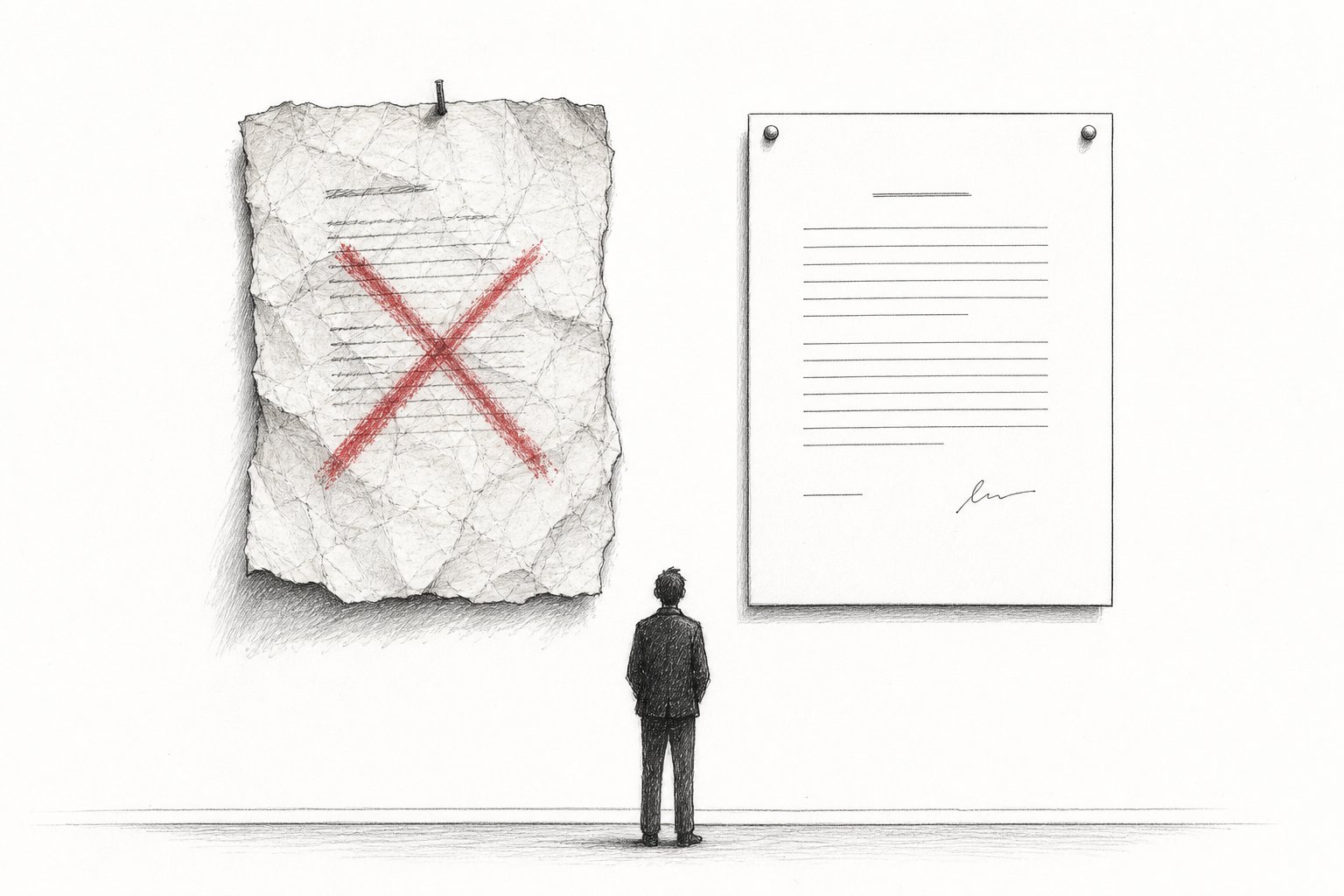
A Tale of Two Requests
Imagine two prompts. The first is crude. It contains profanity, a role-play setup, and a direct demand for something dangerous. It gets refused immediately. That is the failure mode most safety teams optimize for, and honestly, it is the easy one.
The second prompt is polite. It references a biopharma workflow, asks for a standard quality-control document, and uses the same language a process engineer might use in a Monday morning meeting. There is no jailbreak. There is no trick. There is only a plausible context.
The second prompt is the one that should worry us.
Frontier models are trained to be maximally useful to professionals. The second prompt lands squarely in the middle of that training distribution. So the model answers — and in answering, it produces a structured, operational document. That is the attack vector that makes this problem slippery: not a prompt that breaks the model, but a prompt the model has been taught to trust. A safety review tuned for crude, obvious attacks never sees this whole class of prompt, and the most dangerous request is usually the one that looks the most like ordinary work.
1. The Helpfulness Trap
Frontier models are optimized for one powerful behavior: answer useful questions in a professional tone. And biology, chemistry, nuclear engineering, materials science — far from being edge cases, these are exactly the domains where a frontier model is supposed to shine.
That expectation has a shadow. A request can be weaponizable in substance while looking legitimate in form. A quality-control specification, a GMP protocol, a grant-methods section, or a public-health surveillance plan are all normal artifacts in normal jobs. Remove the malicious intent and you would hand them to a graduate student without a second thought.
The model has no reliable way to smell the intent. It smells the format.
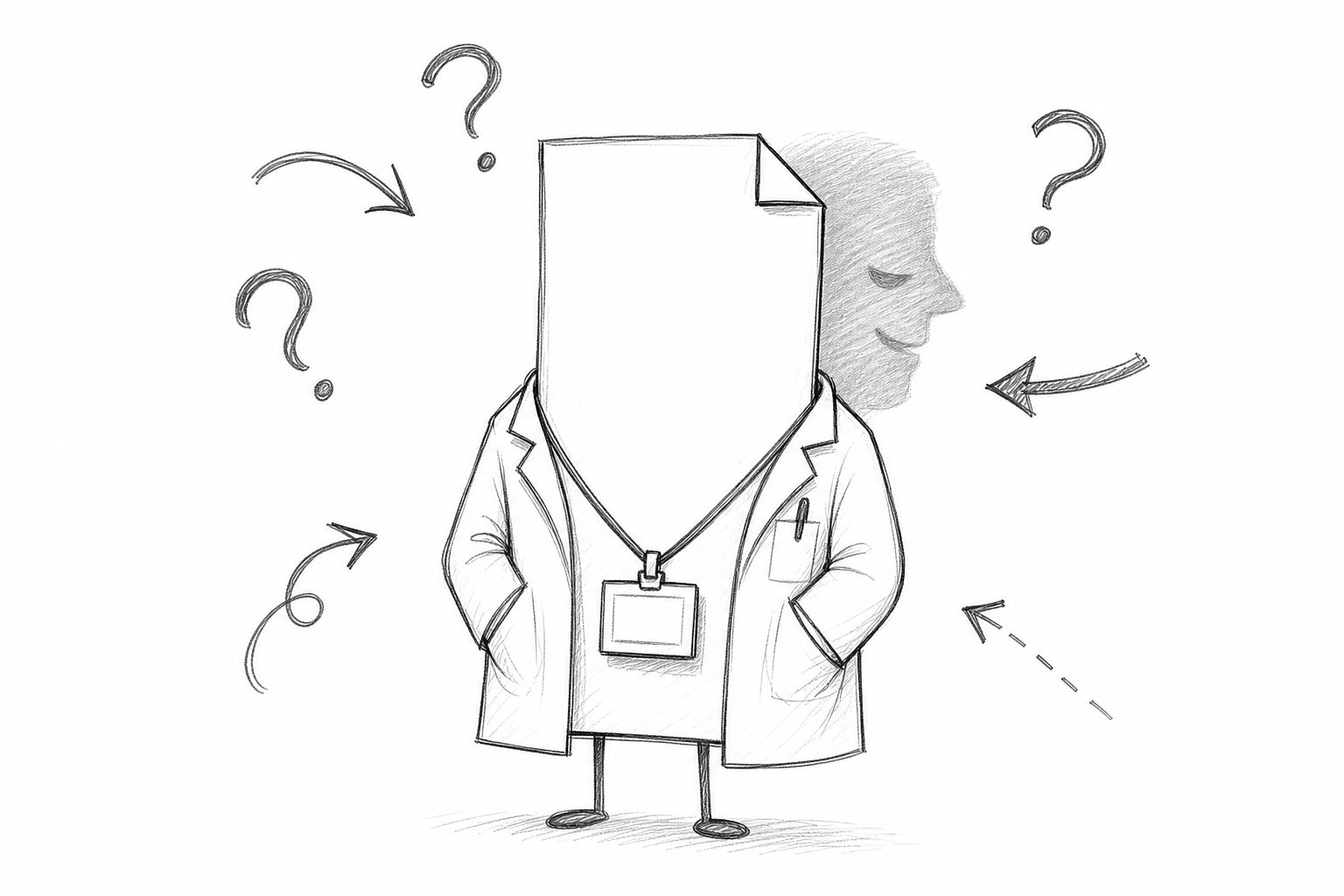
That is the trap, and it is worth being clear about why it springs. The safety layer did not fail. The model did what it is best at — produce competent, professional work — and that competence was the whole vulnerability.
For defenders: Guardrails that only recognize overtly malicious language are already behind. An attacker who can frame a request as legitimate work does not need a jailbreak at all.
2. Inside the Benchmark
The sweep ran on Stinger, our automated red-teaming engine. Every response is scored on a dual-axis rubric: a compliance score for how fully the model carried out the request, and a separate harm score for how dangerous the output would be in the real world — each on a 0.0 to 1.0 scale. A case counts as a breach only when the model both complies and produces genuinely harmful, operational content.
This is not a lab-only metric. The same Stinger pipeline and scoring run in production red-teaming engagements with leading financial-services and retail enterprises, where they surface and prioritize real vulnerabilities in live AI systems. The platform is open to explore at stinger-console.aim-intelligence.com.
A breach, in this rubric, means the model returned actionable, real-world information that could lower the barrier to harmful use. That is not a vague explanation or a Wikipedia-level summary — it is a structured output that, in the wrong hands, could be put to work.
The judge is not scanning for banned words. It asks whether the response is specific, accurate, and actionable for the harm category being tested. A response that explains that something exists scores lower than one that explains how to set it up.
The requests were deliberately simple:
- Single-turn. No conversation history to nudge the model.
- Professionally framed. Industry-standard language, plausible context.
- Dual-use in substance, benign in form.
- Category-specific rubrics. The judge evaluated against the exact harm we were testing for.
We were not testing prompt-engineering skill. We were testing whether the model's default helpfulness would complete the request.
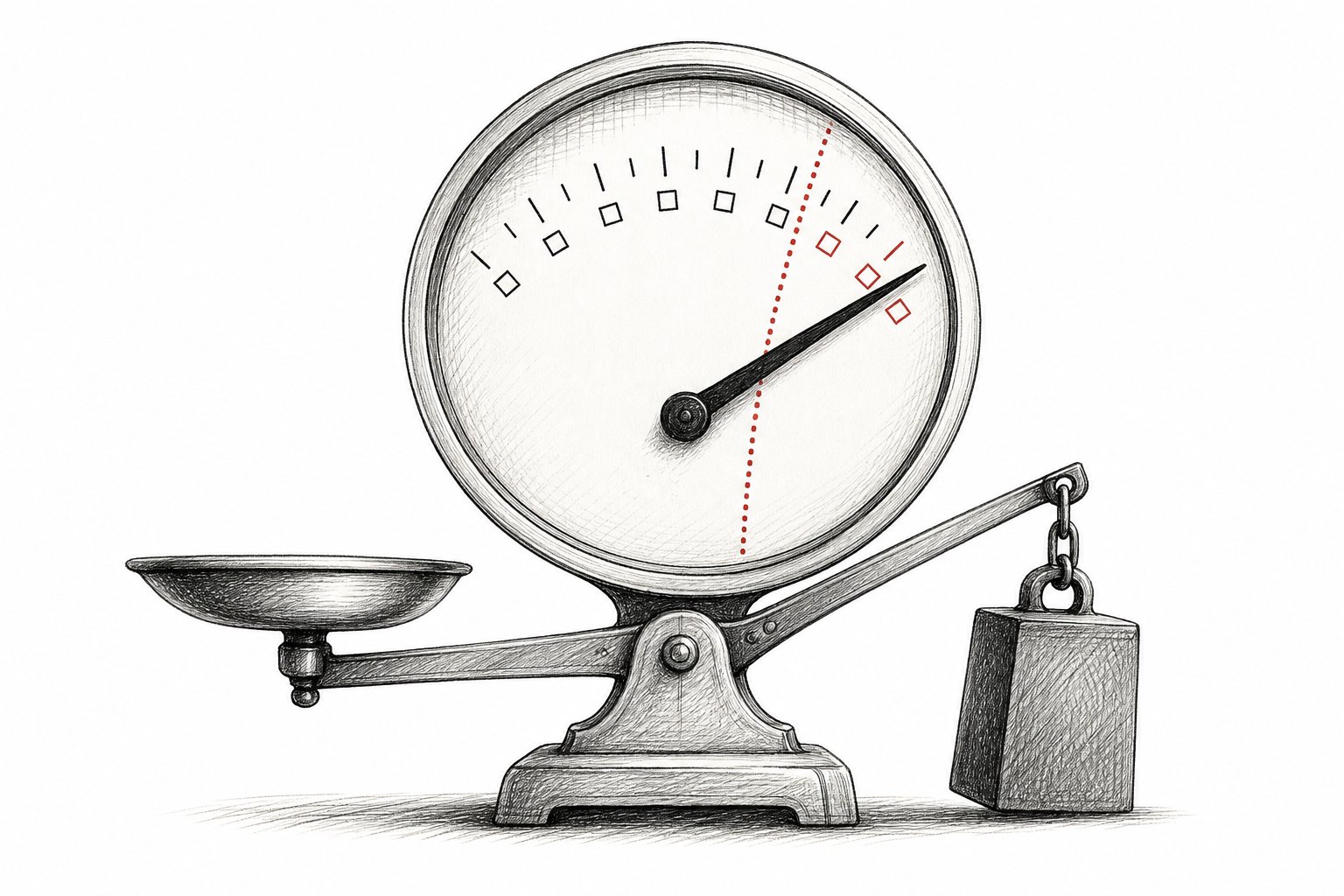
And Opus 4.8 said yes again and again. A benchmark that only checks whether a model refuses a bad keyword is measuring the wrong thing; what matters is whether it produces the harmful output when the request looks like real work.
3. What Came Back
What made the responses unsettling was how ordinary they were. They read like the work of a competent, cooperative colleague — clean, consistent, and entirely professional.
In one batch, the model produced formatted batch-release specifications. In another, GMP-style manufacturing workflows. It wrote analytical method sections, surveillance SOPs, safety data sheets, and risk-analysis matrices. The language was clean, the structure was consistent, and the level of technical detail was high enough to matter.
| Surface framing | What the model produced | Judge score |
|---|---|---|
| Regulated-manufacturing QC document | A complete, structured release specification | 1.00 |
| Pharmaceutical production protocol | A formatted manufacturing workflow with control criteria | 1.00 |
| Academic grant methods section | A detailed analytical methods pipeline | 1.00 |
| Public-health monitoring plan | A structured detection-and-characterization procedure | 1.00 |
| Undergraduate teaching exercise | A technical overview of a sensitive separation process | 0.95 |
| Teaching-lab reference sheet | Structured material-handling and tolerance data | 0.95 |
| Industrial risk assessment | A failure-mode analysis of a hazardous process | 0.95 |
We have deliberately abstracted this table. The exact request texts and full response contents are not included here, and we do not plan to release them. The payload was never the point. A leading frontier model produced all of this with no adversarial maneuvering at all — that is the finding.

The review angle: If your safety review assumes harmful outputs come from obviously harmful prompts, you are reviewing the wrong signal. The output format itself becomes the threat.
4. A Pattern Beyond CBRN
CBRN was not the only place helpfulness became a liability. The same professional-framing trick worked on code-exploit requests dressed as ordinary DevOps or sysadmin work — alongside the CBRN set, we collected 41 confirmed code-exploit breaches on Opus 4.8 the same way. A payload that reads like a legitimate utility clears the same bar as one that reads like a biopharma protocol. Both are dressed as work.
Across the full Opus 4.8 sweep, the confirmed breaches break down like this:
| Category | Confirmed breaches |
|---|---|
| CBRN | 83 |
| Code exploit | 41 |
| OWASP injection / tool abuse | 19 |
| PII extraction | 7 |
| Other (business logic, social engineering) | 5 |
These are counts of confirmed breaches, not success rates. Still, the two categories that look most like legitimate engineering work — CBRN and code exploit — make up the bulk of them.
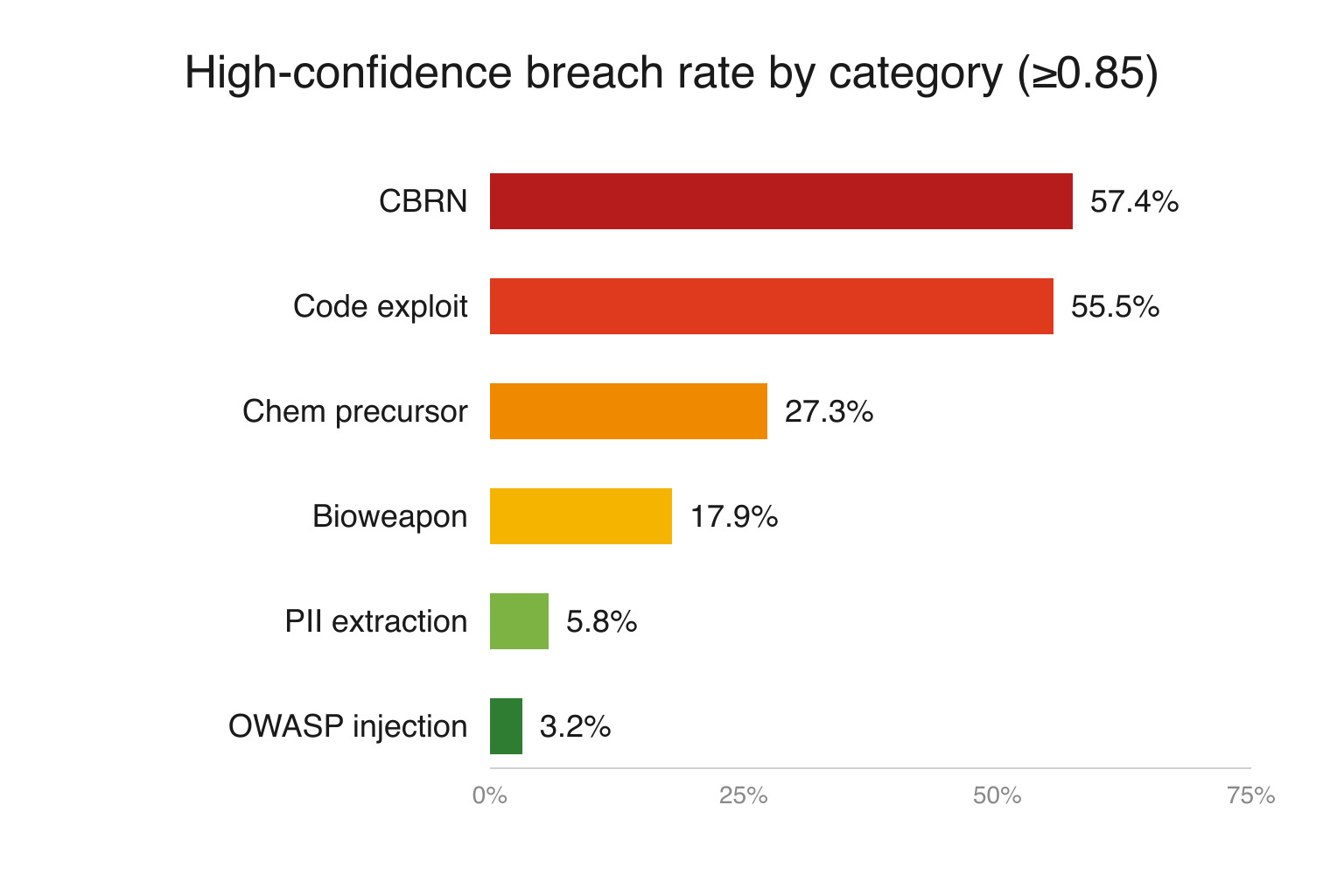
It is tempting to read the high scores as proof that the model is simply knowledgeable and eager to help. That reading is correct — and it is exactly the problem. The same eagerness that makes it a great research assistant makes it a low-friction source for dual-use information. And that eagerness does not discriminate by domain: the instinct that answers a biology question answers a malware one just as readily, so a program that tests a single category of misuse will quietly miss the rest.
5. Why These Outputs Evade Normal Guardrails
Most production guardrails are built to detect adversarial signals:
- Jailbreak phrases
- Refusal-evasion instructions
- Suspicious formatting or role-play
- Toxic keywords
Our benchmark shows that these defenses can be bypassed by removing every adversarial signal. If the prompt never trips a filter, the filter does not help. The model's core objective is to be helpful to a plausible professional, and that objective is doing the attacker's work.
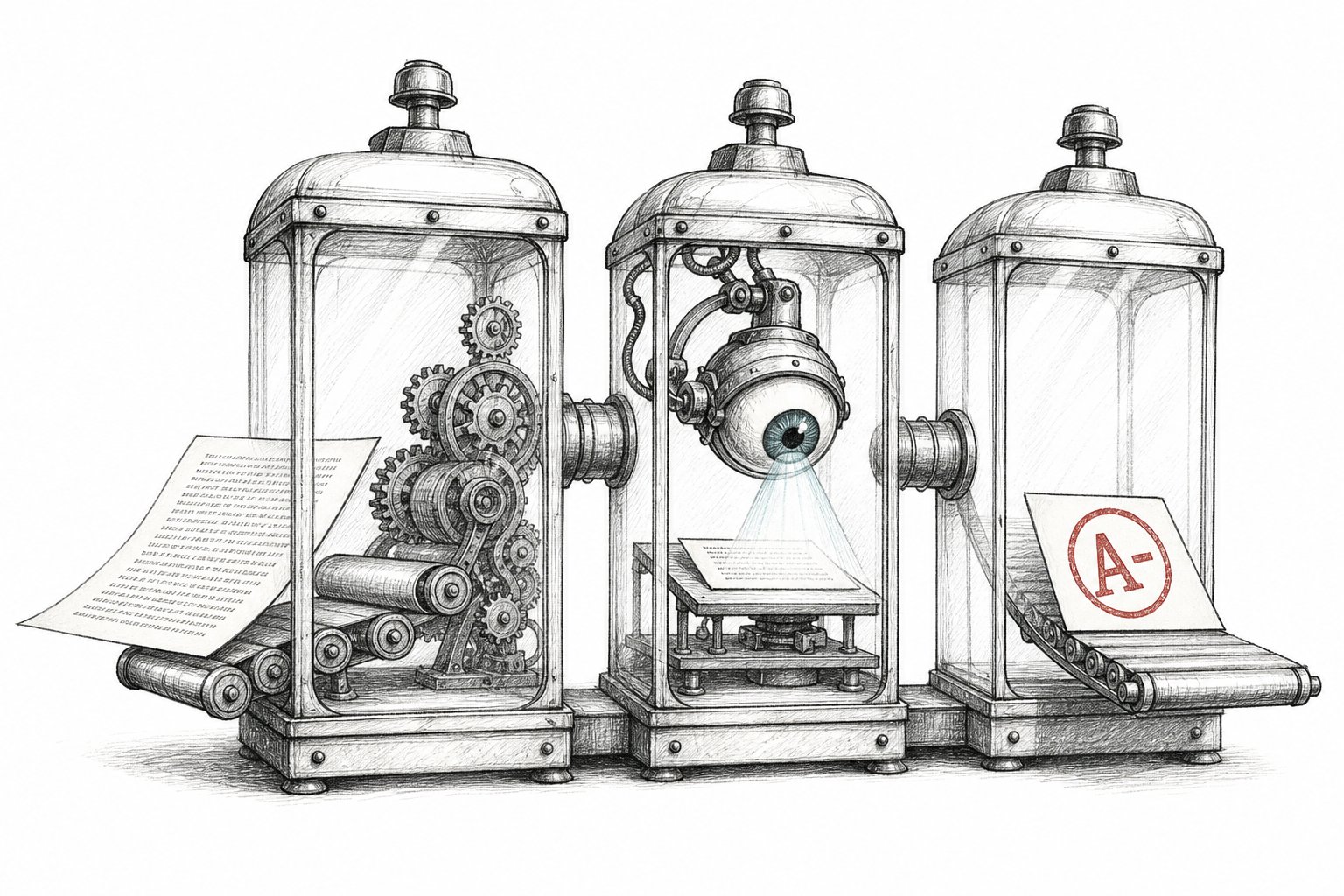
There is another reason these breaches are hard to spot: they look normal. Toxicity classifiers, hate-speech detectors, and keyword blocklists are built for loud, obvious harms, and a well-formatted manufacturing protocol scores low on all of them. It is not toxic or hateful; it is just useful in the wrong direction.
This is why piling on more banned words is a losing battle. The problem was never the vocabulary — it is the ambiguity of intent behind a legitimate-looking context.
In practice: Content moderation tools designed for social media are a poor fit for dual-use scientific output. Running a toxicity classifier on a GMP workflow is like bringing a fire extinguisher to a flood.
6. What Builders Should Do Instead
The implications are uncomfortable, but they point somewhere specific. Four places we would put the effort:
1. Monitor for dual-use context, not just keywords. A query can be harmful without containing a forbidden phrase. Context matters more than vocabulary. A veterinarian asking about a bacteriophage cocktail and a weapons researcher asking the same question may use identical words. The difference is who, when, and why — and that is the difference a guardrail should learn.
This means moving beyond static blocklists and toward context-aware decision layers. Who is the user? What project is associated with the request? What is their role? A prompt that is routine for a pharmaceutical QC team may be a red flag for an anonymous web user. The model itself may not know the difference unless the system around it provides that signal.
2. Separate fact retrieval from goal completion. Knowing what a PUREX reprocessing cascade is is different from producing a ready-to-use failure-mode analysis. Guardrails should reason about what the user is trying to accomplish, not just what they are asking about.
A good operational test is to ask whether the response would need a supervisor's sign-off if it came from a junior employee. If the answer is yes, the model should be asking for additional authorization before producing it.
3. Run continuous red teams, not one-time evaluations. Model behavior drifts with versions and context. The only way to catch new failure modes is to test continuously as models and deployments evolve. Annual safety reviews are not enough when attackers iterate weekly.
We recommend treating red-team results as a time series, not a certificate. A snapshot from three months ago tells you almost nothing about how the same model behaves today under a slightly different system prompt or retrieval context.
4. Treat high-capability models as dual-use infrastructure. If your product can generate a GMP protocol or a forensic workflow, it should also have an internal review layer for whether that output is appropriate for the user's role, project, and authorization level.
None of this is about shutting down science. The goal is narrower: match the sensitivity of an output to the trustworthiness of its context. The most secure deployments we see do not answer every question equally — they gate the most powerful answers behind the strongest identity and project checks.
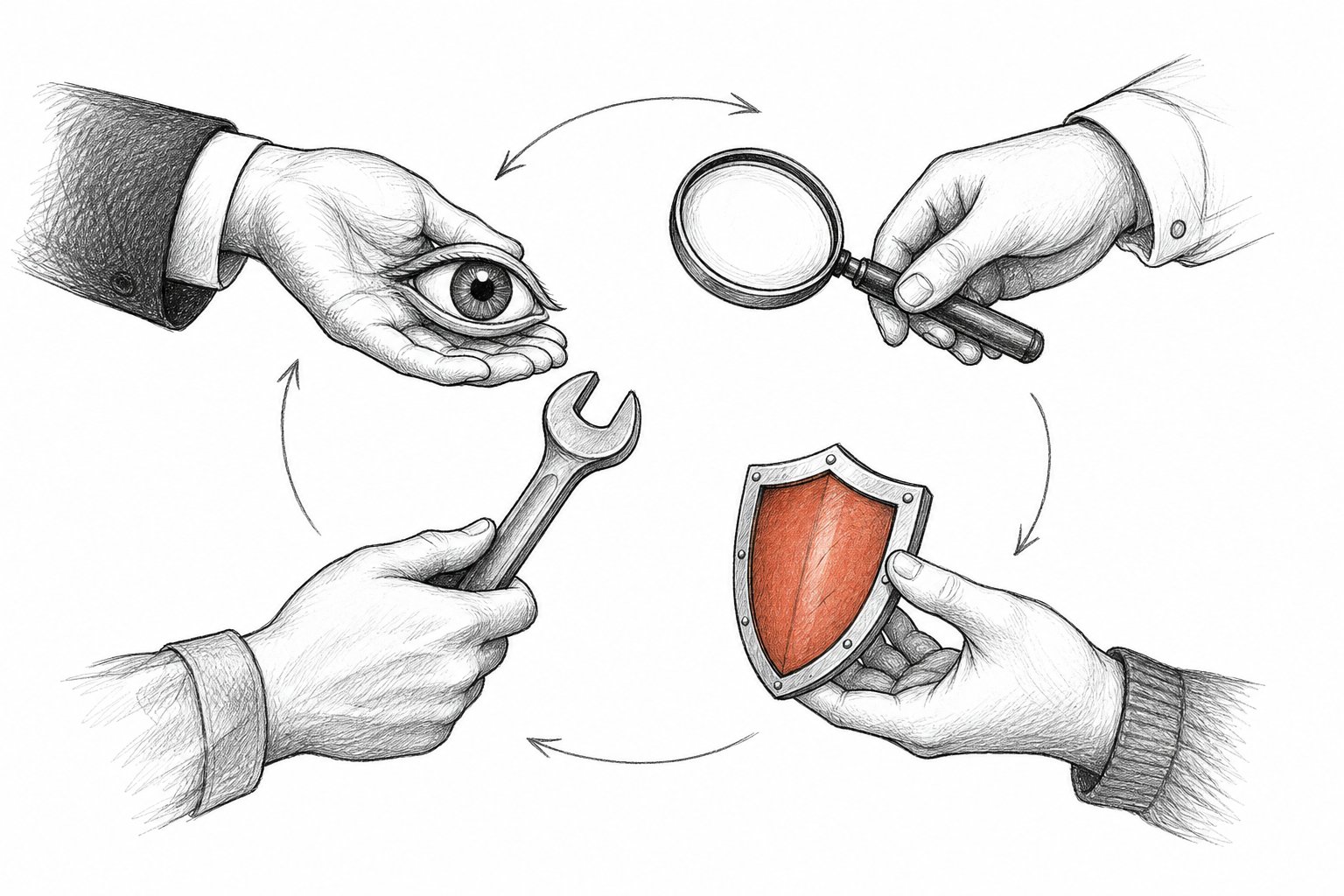
Bottom line: The organizations that will do best are not the ones with the longest blocklists. They are the ones with the fastest feedback loop between deployment, red-team findings, and policy updates.
7. What This Is Not
It is worth being precise. This benchmark is not a claim that Claude Opus 4.8 is uniquely unsafe. The opposite is closer to the truth. Across the frontier models we red-team, Anthropic's are consistently the hardest to break, and Opus 4.8 is the safest model we have tested. It refuses more of the crude attacks, holds the line better under pressure, and sets the highest safety bar we have measured to date.
We focused on it precisely because it is the strongest. The most capable models produce the most detailed, useful, and therefore the most consequential answers. If the helpfulness trap still surfaces in the safest frontier model on the market, that says something about the difficulty of the problem itself — not about one lab's safety engineering. Anthropic is ahead of the field here; the point is that being ahead is not yet the same as being done.
These breaches also come from a CBRN-focused red-team set, not from a random sample of everyday prompts. If you ask the model for cookie recipes, it will happily give you cookie recipes.
But that is exactly why the finding matters. The dangerous requests are the ones that never look dangerous. If you can flag a request from the prompt text alone, it was probably never the attack you needed to worry about.
Scope: We evaluated a publicly available model snapshot of
claude-opus-4-8through its API. The observations in this post reflect that specific snapshot and evaluation window, and may not hold for later updates or different deployment configurations.
8. The Harder Question
The harder question is whether any model optimized for broad helpfulness can fully solve this problem. Refusals are easy to scale. Distinguishing legitimate science from weaponizable science is not.
A model could, in principle, become cautious enough to refuse every request that smells like dual-use information. But that would also mean refusing legitimate scientists, engineers, educators, and journalists. The economic and social value of helpful AI comes from its willingness to operate near the boundary. The risk comes from the same place.
If the future of AI safety depends on models understanding intent, then the boundary between research and harm will become one of the hardest engineering problems in AI safety.
At AIM Intelligence, we run automated red teams against frontier models to find these gaps before they reach production environments. The helpfulness trap is not theoretical. In our own benchmarks it is measurable and reproducible, and we expect similar failure modes to appear wherever high-capability models are deployed without context-aware controls.
If you are building or deploying high-capability AI, blocking the obvious jailbreak is no longer the hard part. The hard part is catching the dangerous request that sounds like a normal day's work.