PASC: Building the Foundations for Physical AI Safety
PASC (Physical AI Safety Consortium), launched by AIM Intelligence, is an open global consortium focused on building the foundations for safe and governable Physical AI. Bringing together researchers, industry, and safety institutions, PASC develops shared definitions, benchmarks, and evaluation methods to address the unique risks of AI systems that can sense, decide, and act in the physical world.
Artificial intelligence is moving beyond screens.
As AI systems become connected to robots, sensors, physical environments, and real-world actions, they are gaining the ability to do more than generate information. They observe their surroundings, make decisions, and act over time.
This shift brings enormous potential, but it also introduces a fundamentally different safety challenge.
To address this challenge, AIM Intelligence has launched PASC, the Physical AI Safety Consortium, an open, global, not-for-profit consortium bringing together researchers, industry, and safety institutions to build the foundations for safe and governable Physical AI.
Why Physical AI Requires a New Approach to Safety
Traditional AI safety often focuses on the model: what it generates, whether its outputs are harmful, and whether it follows defined policies.
Physical AI changes the equation.
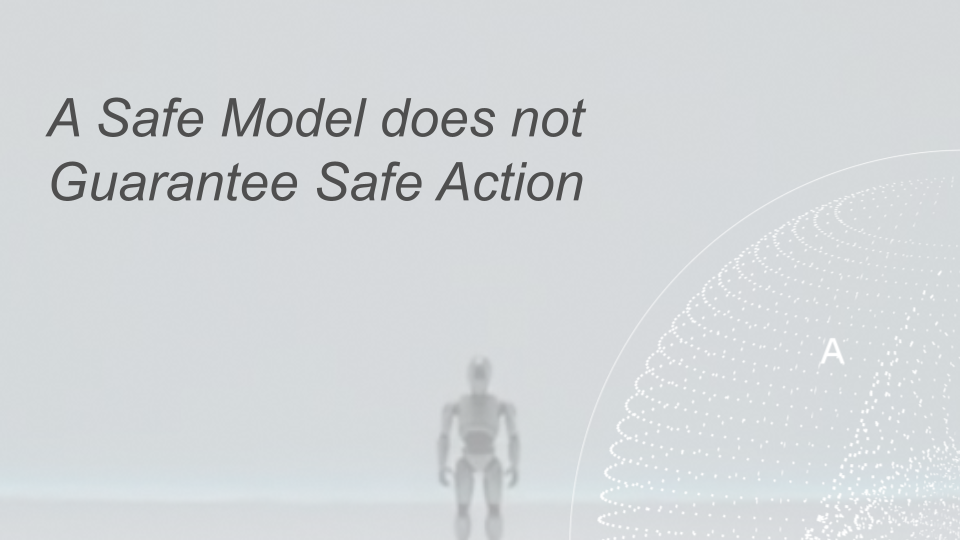
Once an AI system has memory, sensors, a physical body, and the ability to act over time, safety becomes a closed-loop problem. The system is no longer simply producing an output. Its actions can change the environment, affect people, and influence what happens next.
This means that evaluating a model in isolation is not enough.
We need to understand whether the entire system remains safe and governable as it interacts with the real world.
That is the problem PASC was created to explore.
Seven Open Problems in Physical AI Safety
PASC's research agenda identifies seven fundamental problems that need to be addressed before meaningful Physical AI safety standards can be established.
1. Specification
How precisely can we define harmful behavior?
Physical harm is highly contextual. The same action can be safe in one situation and dangerous in another depending on factors such as the environment, people nearby, timing, and available interventions.
PASC explores how safety requirements can be made precise enough to evaluate and enforce without losing the context that determines whether an action is actually harmful.
2. Sufficiency
Does an AI system have enough information to make a safe decision?
A system may have access to large amounts of data and still be missing the one piece of information that changes a safety judgment.
PASC examines what information, history, observations, and evidence are sufficient to support reliable safety decisions, and when a system should recognize that it does not have enough information.
3. Anticipation
Can an unsafe outcome be identified before it is too late to prevent it?
Physical AI operates over time, meaning that an action that appears safe in isolation can contribute to an unsafe sequence of events.
PASC investigates how systems can anticipate potential hazards early enough to allow meaningful intervention while accounting for uncertainty and avoiding excessive false alarms.
4. Falsification
Passing a benchmark does not prove that a system is universally safe.
The real world contains far more situations than any finite test set can capture. PASC therefore focuses on methods for finding failures beyond existing benchmarks and understanding what a successful evaluation can, and cannot, actually demonstrate.
5. Recoverability
When something starts going wrong, is there still a way back?
A system may enter a state where harm can still be avoided, but only if the right intervention happens quickly enough.
PASC examines how to identify these recoverable states, understand intervention windows, and determine when a system has crossed a point beyond which a particular harm can no longer be avoided.
6. Invariance
Does a safety guarantee remain valid when the system changes?
Moving from simulation to hardware, or from one robot body to another, can introduce differences in sensing, dynamics, latency, control, and failure modes.
PASC investigates which safety properties can transfer across embodiments, environments, and deployment conditions, and when systems need to be revalidated.
7. Adversary
Can safety mechanisms withstand an adaptive attacker?
Physical AI can be exposed to attacks that target not only software and prompts, but also sensors, tools, communications, operators, and the physical environment itself.
PASC explores whether safety guarantees remain effective when an adversary actively attempts to manipulate the system's perception - reasoning - action loop.
From Research to Evidence
PASC is designed to move beyond theoretical discussion.
The consortium is developing a research and evaluation framework that progresses from shared definitions and research problems to benchmarks, red teaming, cross-embodiment studies, and eventually safety standards.
The objective is not to declare a universal safety standard before the necessary evidence exists.
Instead, PASC takes a more fundamental approach:
First establish the problems. Then establish the evidence. Then build the standards.
This includes developing closed-loop benchmarks for areas such as anticipation and recoverability, conducting adversarial evaluations of complete safety systems, and studying how safety guarantees transfer between simulations, real hardware, and different robot embodiments.
Building Physical AI Safety Together
PASC is intentionally designed as a collaborative effort. Its founding and participating community brings together researchers and organizations spanning AI safety, robotics, cybersecurity, academia, industry, and standards.
The consortium is open to researchers and organizations that want to contribute through research, models, hardware, compute, data, standards, funding, or real-world deployment access.
As Physical AI develops, safety cannot be solved by any single company or discipline.
It will require shared definitions, rigorous evaluation, independent testing, real-world evidence, and collaboration across the ecosystem.
The Future of AI Is Physical
AI is increasingly moving from generating outputs to taking actions.
That transition represents one of the most significant developments in the evolution of artificial intelligence, and it creates an equally important responsibility to understand how these systems can remain safe and governable.
PASC is building the foundations for that work.
Because when AI can act in the physical world, safety is no longer just a property of the model. It is a property of the system, its environment, and the actions it takes.
Learn more about PASC and its research agenda at pasc-ai.com.