AI Security Digest — June 2026
June 2026 was the month the guardrail became a platform feature. OpenAI shipped in-model activation classifiers, AWS, Google, and Microsoft productized runtime checks within four days of each other, and F5 bundled AI testing with AI runtime defense. Meanwhile the Shai-Hulud/Miasma worm turned 13 AI coding agents into propagation vectors, the US Commerce Department shut down two frontier models over a single jailbreak, and academia converged on structural execution control over blocking. Six stories that defined the month.
If May 2026 was about AI originating attacks, June was about who gets to defend against them — and where that defense lives. Within a single week, three hyperscalers and one frontier lab moved guardrails from a bolt-on product layer into the model and the cloud control plane, while a self-propagating worm demonstrated that the AI agents doing the coding are themselves the softest link in the chain.
Executive Summary
- Guardrails are being absorbed into the platform. OpenAI shipped activation classifiers inside GPT-5.6 "Sol" (intervening mid-generation, not post-hoc), and AWS, Google, and Microsoft each productized runtime guardrail checks within a four-day window. Standalone filtering layers are on a shortening clock; the defensible surface is moving to agent behavior and runtime control.
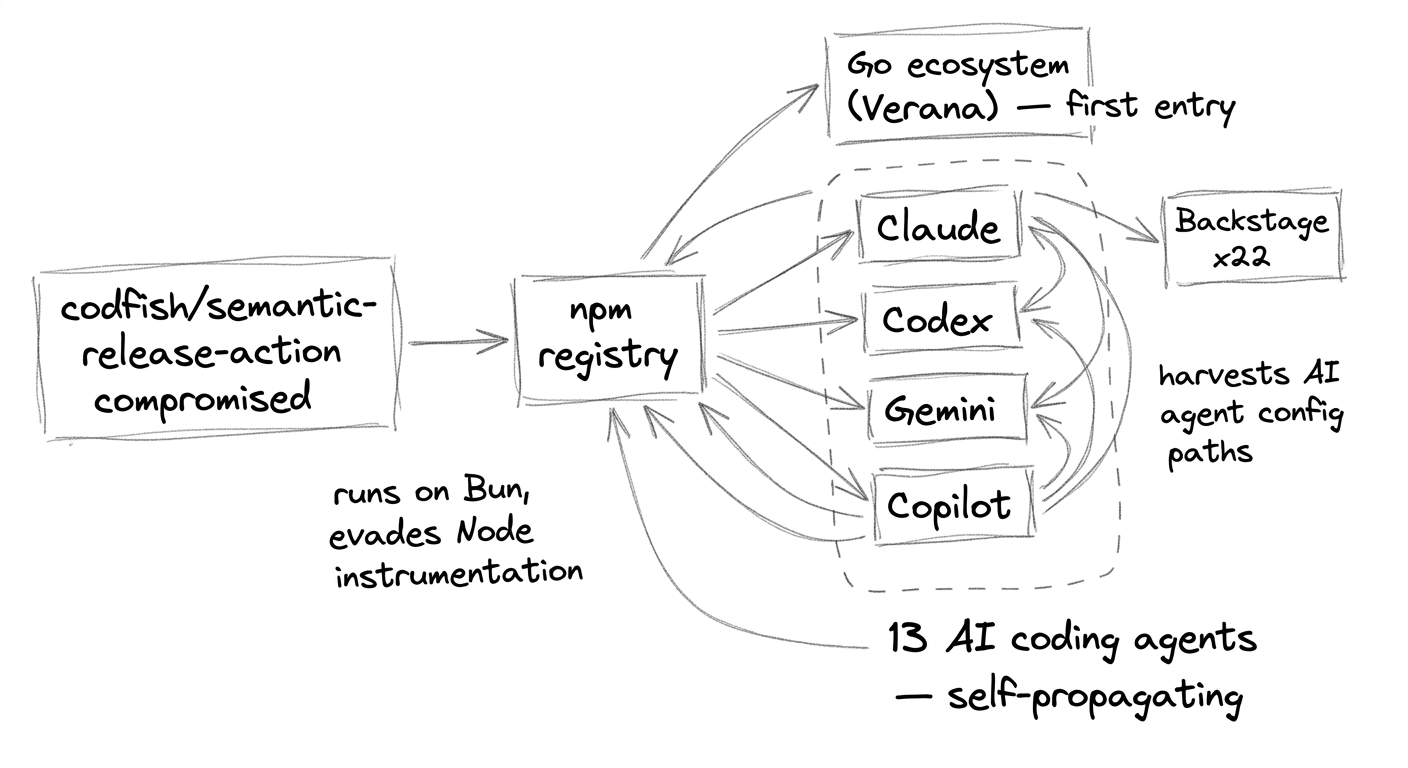
- AI coding agents are now a worm propagation vector. Shai-Hulud/Miasma self-propagated across 13 coding agents (Claude, Codex, Gemini, Copilot and others), entered the Go ecosystem for the first time, and hit 22 Backstage packages — using Bun to evade security tooling and explicitly enumerating AI agent config paths in its credential harvest.
- A single jailbreak is now a regulatory kill switch. The US Commerce Department ordered a full access shutdown of two Anthropic frontier models three days after launch, on the basis of one claimed jailbreak. Independent red-team evidence has been promoted from a nice-to-have to a deployment precondition.
Here are six stories that defined the month.
1. Frontier Labs Absorb Guardrails Into the Model — Four Vendors in Four Days
Date: June 22–26, 2026 · Severity: Strategic · Threat type: Market Structure
On June 26, OpenAI shipped GPT-5.6 "Sol" with activation classifiers — safety classification built into the model's forward pass, intervening during generation rather than screening input and output at the boundary. The distinction matters: a boundary filter sees text; an activation classifier sees the computation that produces it.
Four days earlier, on June 22, three hyperscalers productized runtime guardrail checks nearly simultaneously:
| Vendor | Product | Shift |
|---|---|---|
| AWS | InvokeGuardrailChecks API |
Guardrails as a callable, composable API surface |
| Model Armor v3 | Policy checks in the serving path | |
| Microsoft | MDASH | Cross-workload AI security posture |
The common thread across all four is a move from block/allow to scoring. Rather than a binary refusal, each vendor now returns graded signals that applications are expected to act on — standardizing guardrails as a measured input to a decision, not the decision itself.
Why it matters: The external guardrail layer — a filtering proxy sitting between the application and the model — is being bundled into the model and the cloud platform at zero marginal cost to the customer. Independent vendors whose value proposition is "we filter and score better" are now competing with a free default. What is not being absorbed is anything requiring state across a session: agent behavior over time, tool-call trajectories, MCP runtime control, and feedback loops between offensive testing and runtime policy.
Business impact: If your AI security budget line is a standalone content filter, re-scope it this quarter — you are likely paying for something your model provider and your cloud now ship by default. Redirect toward what platform guardrails structurally cannot see: multi-step agent trajectories, tool and MCP invocation control, and continuous evaluation feedback.
How industry responded: Three of the four vendors converged on scoring-based output within four days without a formal standards process — a de facto interface standard formed by simultaneous shipping. Independent guardrail vendors began repositioning around agent-runtime and evaluation-loop differentiation.
2. Shai-Hulud / Miasma: A Supply Chain Worm That Uses 13 AI Coding Agents to Spread
Date: June 24–28, 2026 (three-wave campaign) · Severity: Critical, ongoing · Threat type: Supply Chain / Worm
The Shai-Hulud worm — first seen in 2025 — returned in June with a variant tracked as Miasma, and this time the propagation mechanism was the AI coding agent itself.
Wave 1 (June 24): Compromise of codfish/semantic-release-action gave the worm a foothold in release automation. From there it self-propagated across 13 coding agents — including Claude, Codex, Gemini, and Copilot — by writing itself into agent configuration and instruction files that those agents read and act on in subsequent sessions.
Wave 2: First confirmed entry into the Go ecosystem via the Verana module — previously the campaign had been confined to npm and PyPI.
Wave 3 (June 26): 22 Backstage packages compromised, reaching internal developer portals.
Two operational details stand out. The worm executes via Bun rather than Node, evading security tooling that instruments the Node runtime. And its credential harvesting list explicitly enumerates AI agent configuration paths — the worm knows where agents keep their tokens.
Why it matters: Rather than attacking the guardrail, this campaign routes around it. An agent that ingests a poisoned config file, dependency, or instruction file is not being jailbroken by a prompt — it is executing what it correctly believes to be its own configuration. Every file an agent reads from outside its trust boundary is supply chain attack surface, and June demonstrated this repeatedly in the wild rather than in a lab.
Business impact: Any organization running AI coding agents in CI or on developer machines should treat agent config files (
.claude/,.codex/, agent instruction files, MCP server definitions) as executable content under change control — not as settings. Credential rotation scoped only to npm tokens will miss the agent-held credentials this worm specifically targets.
How industry responded: Registry maintainers pulled affected packages across npm, Go, and the Backstage plugin ecosystem across the three waves. Multiple agent vendors published guidance on treating agent configuration files as untrusted input; runtime instrumentation gaps for Bun-executed payloads remained open at month end.
3. F5 Launches AI Security Platform and Acquires SurePath AI
Date: June 22, 2026 · Severity: High · Threat type: Market Structure / Competition
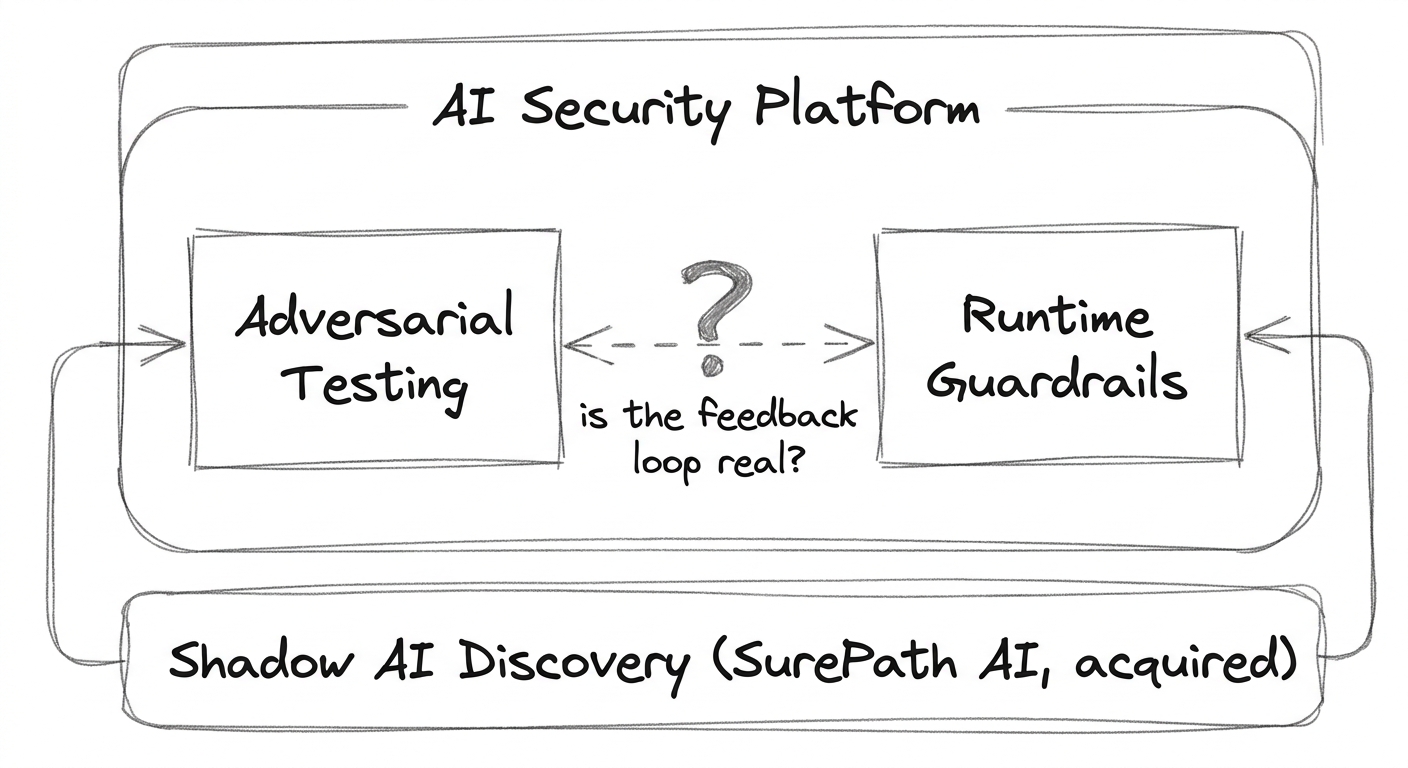
F5 announced an AI Security Platform bundling adversarial testing and runtime guardrails into a single product, and simultaneously acquired SurePath AI for shadow-AI discovery — visibility into which AI services employees and applications are actually calling.
The bundle is notable for what it combines: pre-deployment red teaming and in-production runtime enforcement, historically sold as separate categories by separate vendors, now packaged as one platform with an inventory layer underneath.
Why it matters: An infrastructure vendor with existing application-delivery footprint entering with an integrated story changes the buying process. The "test then enforce" narrative — evaluate a model adversarially, then feed those findings into runtime policy — is no longer differentiated on its own; it is table stakes. What remains differentiated is whether the loop between the two halves is real and continuous, or whether testing and enforcement are simply co-sold products sharing a dashboard.
Business impact: Buyers evaluating AI security platforms should ask a specific question that separates a bundle from a loop: do findings from adversarial testing automatically change runtime policy, and how quickly? An integrated invoice is not an integrated control. Shadow-AI discovery is also becoming a standard platform component — budget for it as inventory, not as a standalone purchase.
How industry responded: The launch accelerated consolidation pressure across the AI security category, with infrastructure and network security vendors moving to assemble comparable test-plus-runtime portfolios through acquisition rather than internal build.
4. Meta Hires the Three Virtue AI Founders
Date: June 25, 2026 (backfill) · Severity: Strategic · Threat type: Competition / Talent
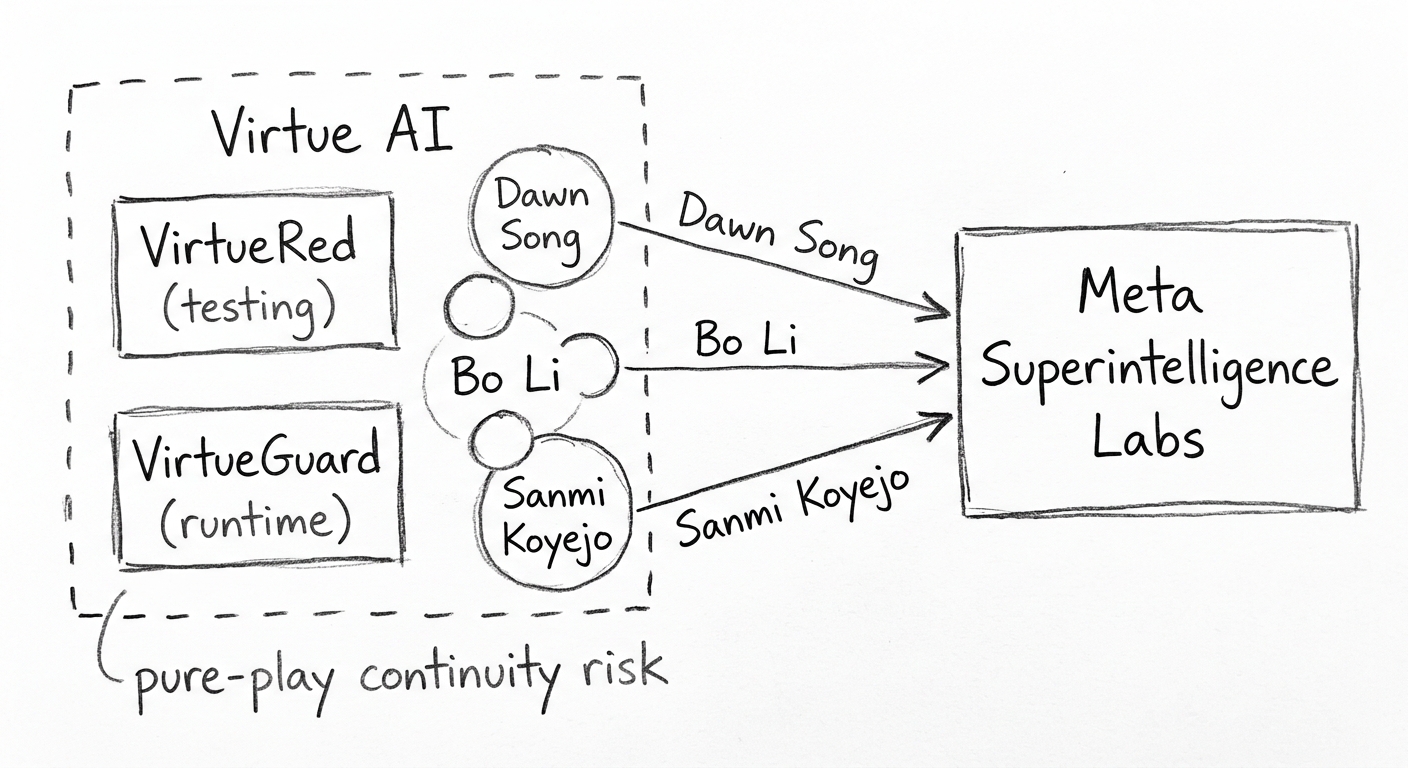
Dawn Song, Bo Li, and Sanmi Koyejo — the three founders of Virtue AI — joined Meta Superintelligence Labs. Virtue AI was one of the most direct pure-play AI security companies in the market, pairing VirtueRed (adversarial testing) with VirtueGuard (runtime guardrails) in the same test-plus-runtime structure that defines the category.
Why it matters: This is the talent-market counterpart to story #1. Big tech is not only absorbing the guardrail product into the platform — it is absorbing the researchers who defined the category. For a field whose credibility rests heavily on named academic leadership, founder departures to a frontier lab are a signal about where the category's center of gravity is moving, and a live question about the durability of pure-play AI security vendors.
Business impact: Vendor due diligence for AI security purchases should now include continuity risk on the research team, not just the product roadmap. If a vendor's differentiation is substantially attached to named individuals, ask what happens to the detection and evaluation methodology if those individuals leave — this month provided the reference case.
5. US Commerce Department Orders Shutdown of Claude Fable 5 and Mythos 5 Over One Jailbreak
Date: June 12, 2026 · Severity: High · Threat type: Regulation × Red Teaming
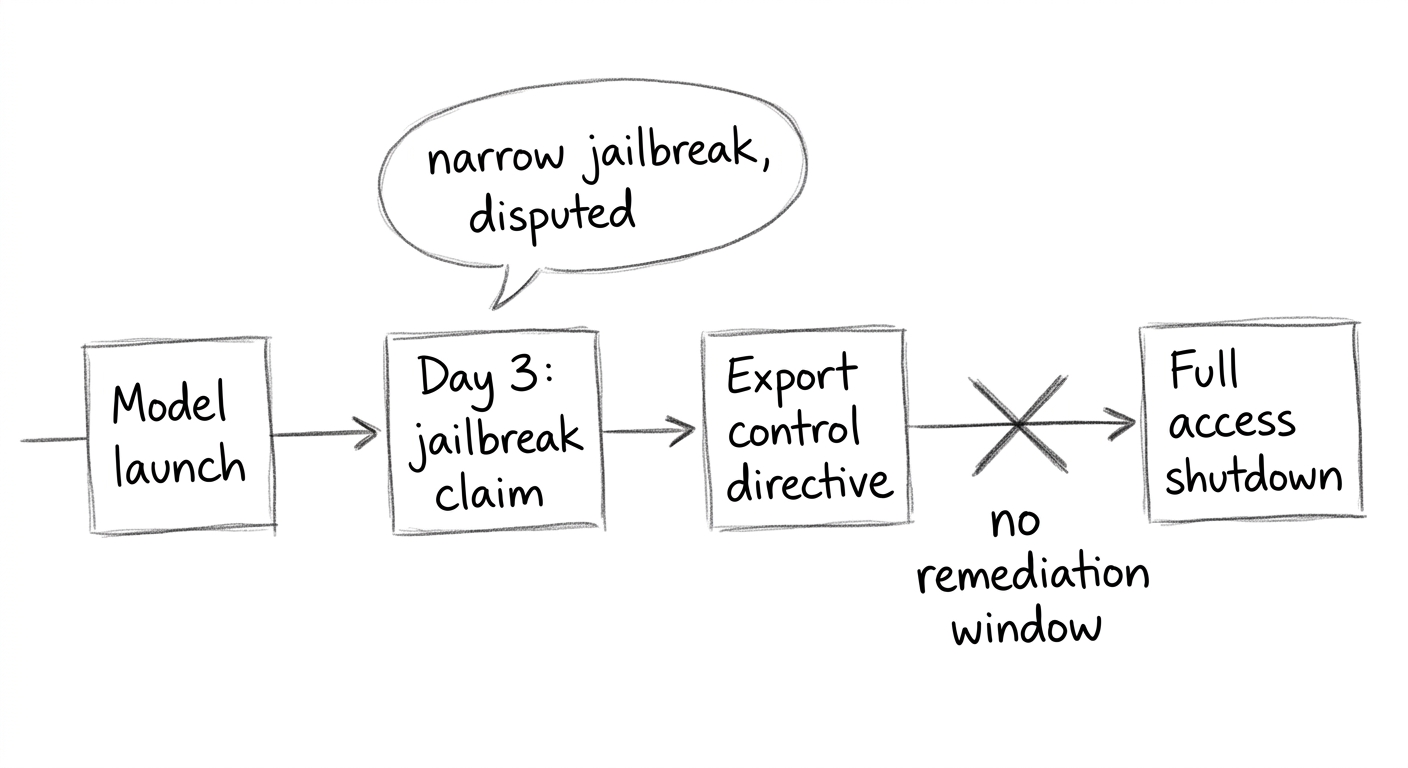
Three days after launch, the US Department of Commerce issued an export-control directive resulting in a full access shutdown of Anthropic's Claude Fable 5 and Mythos 5, on the basis of a single claimed jailbreak. Anthropic disputed the characterization, describing the finding as a narrow jailbreak rather than a general safety failure.
The specifics of the disputed finding matter less than the mechanism: a claimed single-instance bypass moved through a regulatory channel to a total commercial shutdown in three days, with no intermediate remediation window.
Why it matters: Jailbreak resistance has crossed from a product-quality metric into a first-class governance variable. The precedent is that one demonstrated bypass — contested or not — can be sufficient grounds for a regulator to halt a deployment entirely. That inverts the economics of pre-deployment red teaming: the cost of not having independent adversarial evidence is no longer a reputational risk, it is a business-continuity risk.
Business impact: For any organization deploying frontier models in a regulated context, model availability is now a regulatory dependency, not just a vendor SLA. Two concrete actions: maintain a documented fallback model path for any production AI dependency, and require independent red-team evidence — not vendor self-attestation — as a deployment precondition, because that documentation is what a regulator will ask for.
How industry responded: The shutdown triggered debate over the evidentiary standard for a single-bypass finding — specifically whether narrow, non-generalizing jailbreaks warrant the same regulatory response as systemic safety failures. No formal standard for that threshold existed at month end.
6. Academia Converges on Structural Control Over Blocking
Date: June 2026, centered on June 19 · Severity: Thesis validation · Threat type: Technical Trend
Three June arXiv results, from independent groups, arrived at the same conclusion from different directions: refusal-based defense is not merely insufficient, it is actively exploitable.
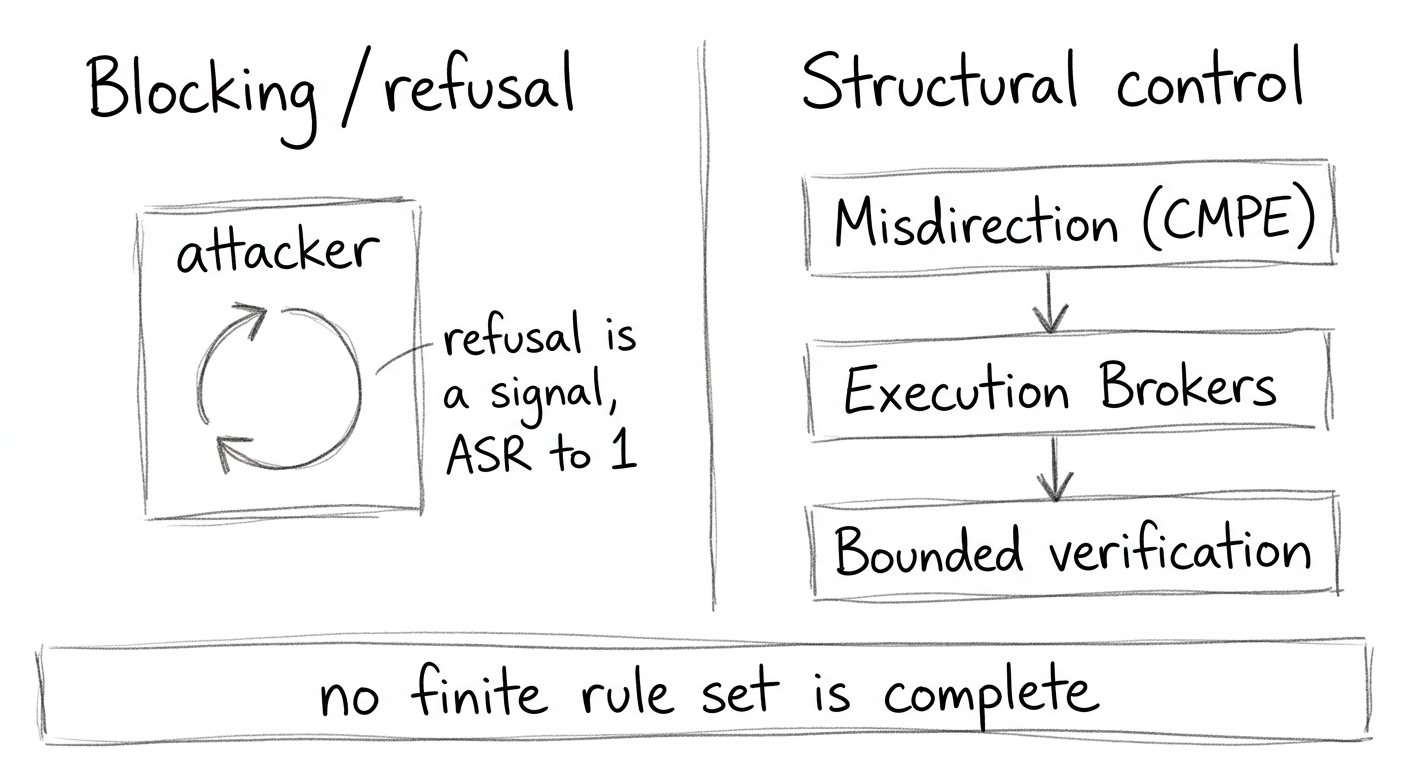
Detect-and-Misdirect / CMPE. Blocking-style defenses leak information through their refusals. Automated attack loops treat each refusal as a gradient signal, driving attack success rate toward 1 given enough iterations. Misdirection — returning plausible but non-actionable output instead of refusing — removes that signal and lowers the attack success ceiling by up to 100×.
Sovereign Execution Brokers. Certificate-bound, short-lived execution identity for agents. Rather than asking whether an action should be allowed at the point of request, the agent holds a cryptographically bound, expiring identity that structurally cannot perform out-of-scope actions.
Google: probabilistic agent verification. Bounded guarantees on policy violation rate — a provable upper bound rather than a best-effort filter.
The backdrop for all three is the NIST result on Gödel-style limits of guardrails: no finite rule set can anticipate all future attacks. (We covered this in Why AI Security Is Moving Toward Continuous Monitoring.)
Why it matters: These are three different mechanisms — output strategy, execution identity, and verification bounds — converging on a single thesis: defense must move from deciding at the boundary to constraining what execution is structurally possible. Blocking treats the model's output as the control point. Structural control treats the execution environment as the control point, which is the only place where guarantees, rather than heuristics, are available.
Business impact: Architecture decisions made now will outlive the current guardrail generation. When designing agent deployments, favor designs where scope is enforced by short-lived credentials and execution boundaries over designs where scope is enforced by prompt instructions and output filters — the former survives a jailbreak, the latter does not.
The Pattern Across June 2026
The commodity layer and the defensible layer separated this month. Stories #1 and #3 are the same event seen from two altitudes: guardrails-as-filtering is becoming a platform default, bundled by model providers, hyperscalers, and infrastructure vendors alike. What resisted commoditization is everything that requires state and time — agent trajectories, execution identity, and the loop from adversarial finding back to runtime policy.
Attackers stopped fighting the guardrail and started routing around it. The Shai-Hulud/Miasma campaign never had to defeat a safety classifier. It compromised what the agent reads and trusts. As guardrails get better at the prompt boundary, the pressure moves to config files, dependencies, instruction files, and MCP definitions — the inputs an agent processes as authority rather than as content.
Regulation and research arrived at the same verdict from opposite ends. The Commerce Department shutdown (#5) treats a single bypass as disqualifying. June's arXiv cluster (#6) explains why that stance is technically coherent: with refusal-based defense, one bypass is not an isolated failure but a signal an automated loop can amplify. Governance is now enforcing what the research says about the limits of static defense.
This Month's Security Leader Checklist
Actions drawn directly from the incidents above:
- Re-scope any standalone content-filter spend. OpenAI, AWS, Google, and Microsoft now ship guardrail scoring by default. Verify what you are paying for that your platform does not already provide.
- Put AI agent configuration under change control.
.claude/,.codex/, agent instruction files, and MCP server definitions are executable content, not settings. The Miasma worm writes to exactly these paths. - Rotate agent-held credentials, not just registry tokens. The June credential harvest explicitly enumerated AI agent config paths. Scope rotation accordingly.
- Audit for Bun-executed workloads in CI. Node-runtime instrumentation did not observe this campaign's payloads.
- Establish a documented fallback path for every production model dependency. The June 12 shutdown removed two frontier models from availability in three days with no remediation window.
- Require independent red-team evidence as a deployment gate. Vendor self-attestation is not what a regulator asked for this month.
- When buying an AI security platform, test the loop. Ask whether adversarial findings automatically change runtime policy, and how fast. A shared dashboard is not a feedback loop.
- For new agent deployments, enforce scope with credentials and execution boundaries — short-lived, narrowly bound execution identity — rather than with prompt instructions and output filters.
AIM Intelligence monitors the global AI security threat landscape and publishes this digest monthly. For deeper analysis of any incident above, see our research posts or contact us.